How bad is using AI for the environment?
AI uses a lot of energy, but so do many things in our lives. How does it compare, and how can we reduce our environmental impact when using AI?
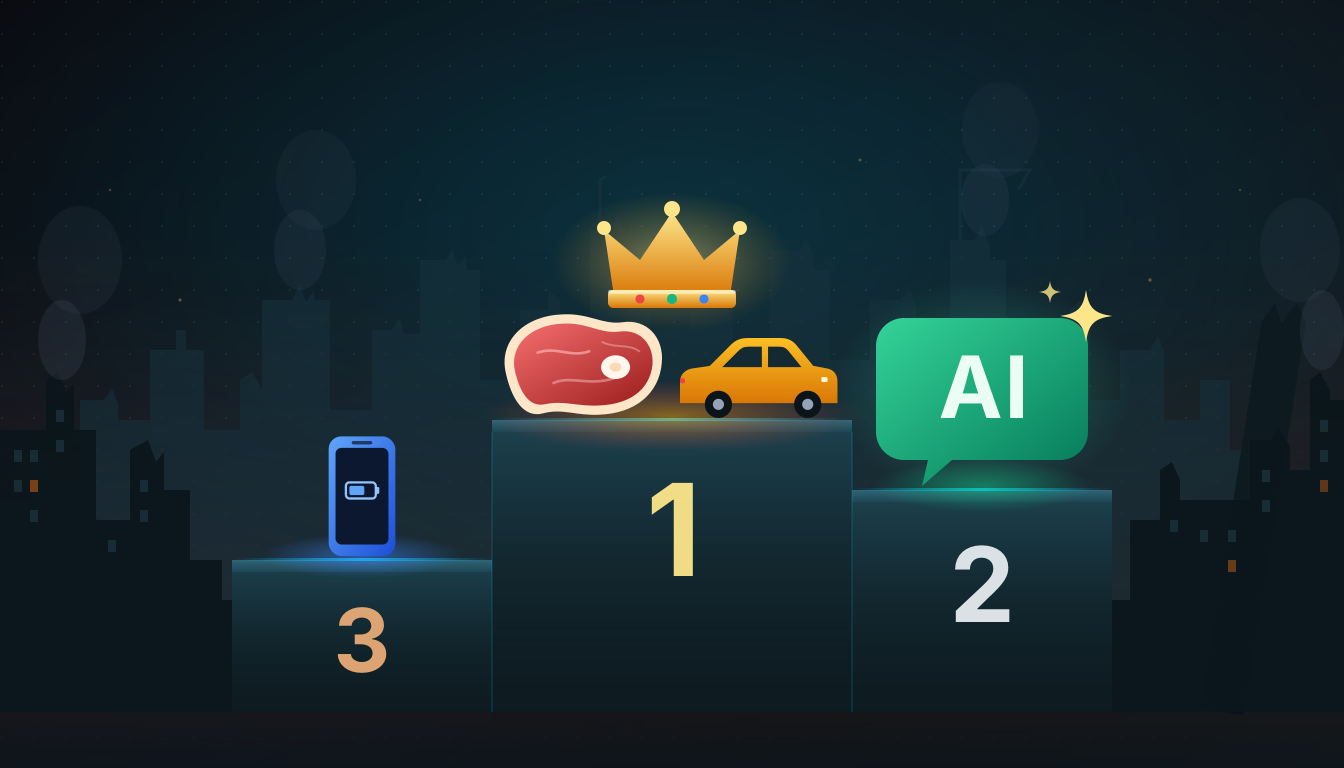
As a data scientist and AI engineer, there are few questions I get as often as this one: how much energy am I "wasting" when I use AI? How much CO₂ am I emitting, and how much water am I taking from the locals every time I ask a chatbot something?
Honestly, it's both a lot and not that much... Yes, AI uses a lot of energy. But in the world we live in, it gets overshadowed by other things we do every day, like driving a car or eating meat.
In this blog I'll put things into perspective and help you answer the question: how bad is it when I use AI, really? All numbers come from the AI energy calculator I built, and every example has a button that opens it in a new tab, so you can play with it yourself.
We will mainly focus on CO2, energy and water aspects of running AI since these are the main concerns about the use of AI.
This blog is about you. If you're wondering what AI costs your company, see How to use AI responsibly as a business (coming soon), and for the planet as a whole, How bad is AI for the environment? (coming soon)
How many tokens do I use?
Before we dive into the costs of AI, we first have to make sure we understand what using AI actually means. AI models read and write text in small chunks called tokens, roughly three-quarters of a word each, and tokens are what cost energy. So here are a few examples to give you a feel for how many tokens you burn through with your tasks.
In this blog I'll stick to text and leave images out, since text is what most of us use day to day.
Small tasks (~1,000 tokens)
On the low end of the spectrum you have the mundane tasks: rewriting an email, answering a few questions, asking for a recipe or generating a personal letter for your best friends birthday... These are the tasks a lot of people use AI for every day, and to some they already feel like a huge CO₂ burner.
Click through the tabs to get a feel for some of these use cases.
Paste a draft, ask for it to sound more professional, shorter or friendlier. The most common thing people use a chatbot for. The typical one: 485 tokens of message and answer, about a page of text.
Large tasks (~1,000,000 tokens)
Then there are the bigger tasks: digging into a research question, building a simple website or adding a feature to your product. These can easily outcompete the small tasks by three orders of magnitude.
Ask a question that needs the web: the AI searches, reads pages and writes a report. Every page it reads is added to the conversation and read again on the next call. The typical one: 1.16M tokens, as much as 337 short chats.
In these kinds of tasks the context tends to grow and grow. The AI researches a lot and drags all that information into the conversation.
This is where we run into the cache. When an answer is generated, the provider stores the conversation so far, so it doesn't have to recalculate all of it for the next message. It's a bit more complicated but an extensive explanation is outside the scope of this blog, but you can read up on it in the cache section of the calculator blog.
From a thousand to a million
As you can see, the number of tokens you burn after sending a prompt to an LLM varies enormously. I hope this helps you get a grasp of how much you tend to use for your work.
The cost of your AI usage
So now that we're on the same page: how much does all this cost? And how does it compare with other things we do?
These values are best guesses. Precise numbers on the energy use of AI aren't published for every model on every server, so we have to make some assumptions. Values also vary a lot on different factors, so the values we take could be off by a factor of two on either side. You can check the assumptions in more detail in the settings of the calculator.
How much energy and CO₂ does a single AI chat cost?
Have a short chat with a chatbot, like polishing an email, and you've used just under a watt-hour (that's the average of the 50 short chats above). But those are just numbers, and what do numbers mean anyway, right? In CO₂ terms that's the equivalent to driving a petrol car about a metre and a half. You'd need around 2,600 of those short chats to drive a short commute of 4 kilometres, and around 16,000 for a 25-kilometre one.
So yes, AI uses energy. But your car is a lot worse.
Open the short chat next to a one-way commute of 26-ish km (Rotterdam to Den Haag)Opens the calculator in a new tab with this exampleWhen I compare with "your commute" in this blog, I use two of them: a short commute of about 4 kilometres each way, a quick drive across town and common in most countries, and a medium commute of about 25 kilometres, the average Dutch car commute, roughly Rotterdam to Den Haag1. A long commute of about 70 kilometres, Amsterdam to Rotterdam, is much rarer: only about one in ten commutes is 50 kilometres or longer.
So using AI isn't bad at all, right?! The car is barely leaving your parking spot at this point. Let's now compare the same chat with something else: charging your phone4. A short chat equates to about 5% of a phone charge. But have a long chat, the kind where the AI searches the web for you, builds a small website or fixes a bug, and you're now at a whopping 200%... That's two full charges, for about 37 Wh (the average of the 25 long chats above). Suddenly it feels different, doesn't it?
Nothing changed except the comparison. Next to a car, AI looks harmless; next to a phone, it looks huge. Most headlines about AI's footprint are really a choice of comparison, so it pays to look at more than one.
Open a long chat next to a phone chargeOpens the calculator in a new tab with this exampleAnd how much water does a chat cost?
Data centres evaporate water to keep their chips cool, and the power plants behind them evaporate even more. A short chat costs about 1.6 millilitres, a third of a teaspoon. A long chat is about 70 millilitres, a small glass and 0.1% of a shower. Most of that isn't the datacenter at all: in the calculator's default (AWS in Virginia) about 96% is used at the power plants.
How much depends on what the grid runs on. Coal and nuclear plants evaporate water in their cooling towers, wind and solar use next to none, and hydro dams lose water from their reservoirs (how much of that to blame on electricity is disputed, because reservoirs also serve farms and drinking water). So a clean grid isn't always a dry one: the calculator counts about 15 litres per kWh for hydro-heavy Norway and under 1 litre for gas-heavy Singapore.
You'll find scarier numbers online, like "a bottle of water per conversation". Estimates per prompt run from a quarter of a millilitre (Google and OpenAI, counting only their own buildings) to around 15 millilitres (researchers who also count the power plants)5. The bottle came from an early study on GPT-3-era hardware, and its authors now reportedly give a much lower figure for today's models.
So for you, it's tiny. The problem is where it happens. A datacenter takes all its water from one place, often drinking water, and most of it on the hottest, driest days. In July 2022, while OpenAI was finishing GPT-4, Microsoft's datacenters in West Des Moines, Iowa, used about 43 million litres, 6% of all water in the local district6. Microsoft's datacenters in Middenmeer used 84 million litres of drinking water in 2021, four to seven times what the municipality had told residents7. That wasn't for AI yet, but AI runs in the same kind of buildings, and it's the main reason so many more are being built. And clean water is getting scarcer: about half the world's people face severe water shortages for part of the year8, and even in the rainy Netherlands, Vitens has had to turn away new business connections because there isn't enough drinking water9. A thirsty new datacenter doesn't help.
The bigger picture on this topic will be in How bad is AI for the environment? (coming soon)
How much energy does AI use per day for me?
Before we can truly describe your personal impact, we have to establish how much of an AI junkie you truly are. So I created three personas, each one a working day of AI:
- The light user polishes an email from time to time and asks some mundane questions: 10 short chats a day.
- The intense user uses AI as a personal assistant for many tasks during the day: 50 long chats.
- The power user maxes out their $200-a-month subscription from time to time: two 5-hour Claude Code windows10.
I'm leaving out the power² users here, the ones who max out multiple accounts all day, every day. These people are truly nuts and belong to the top 0.01% anyway.
These are personas, not averages. Nobody publishes how many tokens a typical office worker uses. The closest there is: ChatGPT users send about 3 to 4 messages a day on average, and most of that isn't for work11. The three users here are there to make the numbers concrete, from very light to as heavy as it gets.
Tokens are what the model reads and writes; what counts for the climate is the CO₂e. So here are the three users next to activities that might be part of your daily routine: charging your phone4 or laptop12, a commute by car13, and 100 grams of chicken or beef14.
The AI, the phone and the laptop all run on electricity, so where that electricity comes from matters a lot15. Switch the grid and watch those bars move; the car and the meat stay where they are.
A working day, in CO₂e
Electricity from Ashburn, Virginia, 418 g CO₂e per kWh: gas, renewables and some coal, like the Netherlands and Germany.
The grid makes a big difference. On a low-carbon grid, like Sweden's, even the power user stays below a portion of chicken; on a coal-heavy one the intense user creeps up to almost a full portion. From here on I use the mixed grid, like Virginia, the world's biggest data centre hub.
A year of AI next to a year of driving
One day is one thing. What about a whole year?
Take the intense user's day, 50 long enquiries, and repeat it every working day: 250 days. That's about 320 kWh and 135 kilograms of CO₂e, the same as driving about 600 kilometres. The car commuter from Rotterdam to Den Haag drives about 11,000 kilometres a year just to get to work and back, and emits about 2.5 tonnes doing it. Someone with a short 4 km commute drives about 2,000 kilometres a year and emits about 450 kilograms.
So a whole year of heavy chatting is about 5% of a year of medium commuting, and about 30% of a short one.
Open a year of 50 long chats a dayOpens the calculator in a new tab with this exampleProgrammers who max out a 5-hour Claude Code window every working day end up higher: this equates to 950 kWh and 400 kilograms a year, around 1,800 kilometres of driving. That's a real number: about 16% of the medium commute, and almost as much as the whole short commute. Still, the medium commute is six times bigger.
What am I contributing?
So my AI use is small next to my car. But "small next to my car" isn't the same as "nothing". Let's zoom out once more.
If everybody on earth, all 8.2 billion of us16, used AI like the intense user does all year, the world would need about 2,600 TWh a year for it. That's more than six times what all data centres in the world use today, AI and everything else together17. Of course nobody chats like that, let alone everybody. But it shows why AI's footprint is a question of scale: tiny for one person, huge when billions of people do it every day.
And for me personally? An average Dutch person is responsible for roughly 8 tonnes of greenhouse gas a year (the country's 144 million tonnes18 divided over 18 million people19). My 135 kilograms of chatting is under 2% of that. A 25 km car commute is about 30%.
So the honest answer is: you're contributing something, but not much. If you want to make a difference, your car, your flights, eating meat and your heating are where the tonnes are. And if you work at a company, the bigger lever is there; more on that in How to use AI responsibly as a business (coming soon). For the world as a whole, see How bad is AI for the environment? (coming soon)
So, should you feel guilty?
For a short chat: no. A single chat is tiny next to a car trip, a shower or a steak. But "tiny" times billions per day is not tiny, and agents that work for hours use thousands of times more than a chat. The useful question isn't "Is it bad if I use AI for this task?" but "How can I use AI responsibly in order to reap the benefits while having a minor impact on our environment?" Those choices can make a 100-fold difference.
How to use AI sustainably: 6 ways to shrink your footprint
There are a few things you can do to keep your personal CO₂ footprint low while still enjoying AI.
1. Do some straightforward tasks yourself
Maybe you don't need AI to change the colour from blue to green on your website? A small edit you can make in ten seconds doesn't need a model that re-reads your whole project first.
2. Start a new chat instead of continuing an old one
A long chat history increases the cost of creating new text, because every new message re-reads the whole conversation. The cache helps a lot here, but even the cache isn't a magic bullet that cancels it out completely. Of course, in some cases the chat history is vital/important in order to answer the question correctly, so decide for yourself when a new chat is the best decision.
3. Use a smaller model when possible
Fable (Anthropic) and Astra (OpenAI) probably use significantly more energy than their smaller counterparts, Opus and Sol respectively. Start small, and only upgrade when the answer isn't good enough. That being said, sometimes small models are so ineffective that they actually need more energy to complete the task at hand.
Open the long chat with a small modelOpens the calculator in a new tab with this example4. Turn off extended thinking (reasoning mode)
Most models let you choose how hard they think: low, medium, high, and on some models extra high or max. All that thinking is text too, thousands of hidden words the model writes before you see an answer, and writing is the expensive part. In Microsoft's estimates a reasoning-style query writes about 15 times more tokens and uses about 13 times more energy than a typical one20.
And more thinking isn't always better. A study of 53 models on basic maths found zero accuracy gain from low to medium to high effort on GPT-5 and OpenAI's o-series21. In a test of seven models on short coding tasks, low effort solved every task, and high never solved one that low missed, while costing up to 10 times as much22. Anthropic's own researchers even found that letting models reason longer can make them worse: they get distracted by irrelevant details and talk themselves out of the right answer23.
So medium is a good default. It costs less energy than high or extra high, and sometimes it's actually better. Save the max setting for the really hard problems, and for a quick question go even lower.
5. Think about the cache
This one is a bit trickier, and it's covered in more detail in the AI energy calculator blog. The short version: the provider keeps your conversation in a cache for a few minutes, which makes re-reading it much cheaper. Once that cache has expired, the whole conversation has to be read again at full price. So picking up yesterday's chat costs way more energy than chatting in one sitting.
6. Choose a provider with greener servers
This one is also a bit tricky, since most providers don't tell you which servers your chat runs on, or what powers them. And it matters a lot: the same chat on a Swedish grid emits about 20 times less CO₂ than in Virginia, where much of the American cloud sits15.
Open the short chat on a server in StockholmOpens the calculator in a new tab with this exampleHere's what we know about the big ones:
- Google (Gemini) is the most open. About 65% of the electricity in its data centres was carbon-free in 2025, measured hour by hour, and it publishes an energy figure per prompt24.
- Mistral runs mostly in France, where the grid is largely nuclear, and is the only one that has published a full life cycle analysis of its model: about 1.14 g CO₂ per answer25.
- Anthropic (Claude) and OpenAI (ChatGPT) publish no emissions data at all26. And some of their newest capacity runs on gas: Anthropic rents xAI's Colossus 1 in Memphis27, and at least three of OpenAI's Stargate sites get on-site gas plants28.
- xAI (Grok) is the clear worst. Its data centres around Memphis run on dozens of gas turbines, many of them without a permit, and the temporary ones only have to be gone by July 202729.
Be careful with "100% renewable" claims too. Most of the time that means the company buys as much green energy over a year as it uses. Your chat at 10 at night can still run on gas.
So what can you actually do? If you only use the chat apps, not much beyond picking Gemini or Le Chat over the others. If you use AI through an API or a cloud platform, you can often pick the region: a data centre in Sweden or Finland beats one in Virginia by a mile. And open models can run on GPU clouds in Iceland and the Nordics that run on hydro and geothermal power.
Want to try your own day? Open the calculator, pick your own cities, car and model, and see where you end up.
Footnotes
-
Average commute trip of a car driver in 2024: 25.1 km one way, 31 minutes. Commute trips across all ways of travel, per person per year by one-way distance: 0–1 km 10, 1–3.7 km 38, 3.7–7.5 km 30, 7.5–15 km 29, 15–30 km 31, 30–50 km 19, 50–75 km 10, 75 km or more 7. CBS, Mobiliteit; per verplaatsing, vervoerwijzen, motieven, regio's (84711NED) and CBS, Mobiliteit; per persoon, verplaatsingskenmerken, reismotieven (84702NED), both from the ODiN travel survey. Rotterdam to Den Haag is about 23 km by road, centre to centre. ↩
-
People aged 16 and over in employment in England and Wales on Census Day, 21 March 2021, by straight-line distance between home and workplace postcodes, as a share of all workers: under 2 km 11.0%, 2–5 km 12.6%, 5–10 km 11.8%, 10–20 km 10.5%, 20–30 km 4.1%, 30–40 km 1.7%, 40–60 km 1.3%, 60 km or more 1.4%. The chart shows these as a share of the 54.3% who travelled to a workplace; 31.2% mainly worked from home and 14.4% worked offshore, abroad or had no fixed place. The census fell during a lockdown, so fewer people travelled than usual. ONS, Travel to work, England and Wales: Census 2021 and ONS, Distance travelled to work (TS058) ↩
-
Employed people by one-way distance to work, final Mikrozensus 2024 results: under 5 km 27.5%, 5–10 km 22.0%, 10–25 km 28.4%, 25–50 km 13.9%, 50 km or more 5.2%. The other 3.1% work where they live or at changing places. Destatis, Erwerbstätige nach Stellung im Beruf, Entfernung, Zeitaufwand und benutztem Verkehrsmittel (2026) and Destatis press release, 26 May 2025 ↩
-
The EPA counts 0.019 kWh (19 Wh) per smartphone charge; the tool's own phone figures are on the Sources page. US EPA, Greenhouse Gas Equivalencies Calculator: calculations and references ↩ ↩2
-
Median Gemini Apps text prompt: 0.26 mL, on-site water only. Google, arXiv 2508.15734. Average ChatGPT query: about 0.000085 gallons, roughly 0.32 mL. Sam Altman, The Gentle Singularity (2025). The "bottle of water" (500 mL per 10 to 50 responses) is from Li, Yang, Islam & Ren on GPT-3-era assumptions; the same paper projects 4.2 to 6.6 billion m³ of water withdrawal for AI in 2027. Making AI Less "Thirsty" (arXiv 2304.03271). The authors have since reportedly put a GPT-4 prompt at about 15 mL including the power plants, about 5 mL on site. The Atlantic (2026) ↩
-
About 11.5 million gallons in July 2022, the month before OpenAI finished training GPT-4, according to West Des Moines Water Works; Microsoft's president said the Iowa site was built so OpenAI could train GPT-4. Most of the year it is cooled with outside air, and it draws water when it gets hot. AP, via Fox 9 (2023) ↩
-
84 million litres in 2021, against the 12 to 20 million a year the municipality of Hollands Kroon had communicated; revealed by a Wob request from Noordhollands Dagblad. Microsoft says much of it was for construction and that it only cools with water above 25 °C. DCD (2022) ↩
-
As of 2022, roughly half of the world's population experienced severe water scarcity for at least part of the year; 2.2 billion people lack safely managed drinking water. UNESCO, UN World Water Development Report 2024 ↩
-
RIVM expects Dutch drinking water demand in 2030 to be about 100 million m³ higher than in 2020, while drought and salinisation shrink the supply; Vitens has already had to refuse business connections in several places, for example in Twente. NOS, RIVM: snel actie nodig om drinkwatertekort te voorkomen (2023) and Kamerbrief bijlage (blg-1149860) ↩
-
ccusage output for 5-hour blocks on a Max 20x plan: 215 to 364 million tokens, about 99% cache reads. GitHub issue anthropics/claude-code#54750 ↩
-
ChatGPT had about 700 million weekly users sending 18 billion messages a week in July 2025, roughly 3 to 4 messages per user per day; about 70% of consumer messages were not related to work. OpenAI & NBER, How People Use ChatGPT (2025) ↩
-
MacBook Air (13-inch, M4): 53.8 Wh battery; with charger and battery losses about 67 Wh from the wall for a full charge. Apple, MacBook Air (M4, 2025) tech specs ↩
-
Medium petrol car (1.4 to 2.0 litre), 174 g direct plus 50 g for producing the fuel: 224 g CO₂e per km. UK DESNZ, Greenhouse gas conversion factors 2026 ↩
-
Life cycle from farm to shop, per kg of food: beef from beef cattle 99.5 kg CO₂e, beef from dairy cattle 33.3, poultry 9.9. Poore & Nemecek (2018), Science, via Our World in Data ↩
-
Yearly average carbon intensity per grid zone, lifecycle: Sweden (SE3, Stockholm) 20, Norway 24, Iceland 28, France 31, the Netherlands 253, Germany 342, Virginia (PJM) 418, Poland 565, India (Western region, Mumbai) 653, Indonesia 667, South Africa 700 g CO₂e/kWh. The chart uses the AWS regions in Stockholm, Virginia and Mumbai, with each datacenter's own cooling overhead. Electricity Maps yearly data, via the Green Web Foundation's CO2.js ↩ ↩2
-
The world population reached 8.2 billion in 2024. United Nations, World Population Prospects 2024 ↩
-
415 TWh and 1.5% of world electricity in 2024; 12% growth a year since 2017; 945 TWh by 2030; 180 Mt CO₂ today, below 1.5% of energy-sector emissions. IEA, Energy and AI, executive summary ↩
-
2024: industrie 47.1, mobiliteit 29.2, landbouw 25.0, elektriciteit 23.0, gebouwde omgeving 16.4, landgebruik 3.7 Mt CO₂-eq; mobility "wordt voor de helft veroorzaakt door personenauto's". CBS, Welke sectoren stoten broeikasgassen uit? ↩
-
The Netherlands has about 18 million inhabitants. CBS, Bevolkingsteller ↩
-
In the test-time scaling scenario queries are about 15x longer and median energy rises about 13x, to 3.91 Wh. Oviedo et al., arXiv 2509.20241 / Joule 2026 ↩
-
53 LLMs on 14 basic maths tasks; GPT-5 and o-series models show zero accuracy gain from low to medium to high reasoning effort, while reasoning models write far more tokens. Srivastava et al., Do LLMs Overthink Basic Math Reasoning? (arXiv 2507.04023) ↩
-
Seven models on nine short Python tasks via OpenRouter, low, medium and high effort: low scored 9/9 on all seven; high cost 0.96 to 10.28 times as much as low. One run per setting, short tasks only. DataLLM Lab, Reasoning effort: low vs medium vs high on seven models (2026) ↩
-
Extending the reasoning length of large reasoning models lowered accuracy on counting, regression and deduction tasks, across models from Anthropic, OpenAI and DeepSeek. Gema et al., Inverse Scaling in Test-Time Compute (TMLR 2025) and Anthropic Alignment Science Blog ↩
-
Google's data centres used 42 TWh in 2025, up 38.4%; the hourly carbon-free share fell from 66% in 2024 to 65% in 2025. The goal is 24/7 carbon-free energy everywhere by 2030. S&P Global, Google's search for power (2026) and Google, 24/7 carbon-free energy. Median Gemini text prompt: 0.24 Wh. DCD (2025) ↩
-
Life cycle assessment of Mistral Large 2 by Carbone 4 and ADEME: 20.4 kt CO₂e for training, about 1.14 g CO₂e for a 400-token answer from Le Chat, hardware included. Carbone 4, Mission Mistral AI and The Decoder (2025) ↩
-
OpenAI and Anthropic have published no audited sustainability reports and no Scope 1, 2 or 3 emissions; Anthropic works with Watershed to measure its footprint. Fortune, AI giants are quiet on climate (2026) ↩
-
On 6 May 2026 Anthropic got access to all of Colossus 1 in Memphis, over 220,000 GPUs and more than 300 MW. xAI, Anthropic compute partnership and Capacity (2026). The site's grid connection is about 150 MW, and it has been powered partly by gas turbines: in 2025 xAI said 15 were in use, aerial footage showed 35. Wikipedia, Colossus (supercomputer) and The Register (2025) ↩
-
At least three of the seven US Stargate sites, including Abilene, use on-site natural gas plants. Epoch AI, OpenAI Stargate: where the US sites stand (2026) ↩
-
In July 2026 SpaceX, which now owns xAI, said it runs 69 temporary gas turbines at its Southaven site in Mississippi, just across the state line from Memphis, to power its Colossus data centres. Counts of the unpermitted ones range from 27 in an April 2026 lawsuit to 59 in regulator emails. Under an agreement with Mississippi regulators all temporary turbines go by July 2027, replaced by a permanent 1.2 GW gas plant with 41 turbines. TechCrunch (2026) and The Next Web (2026) ↩